
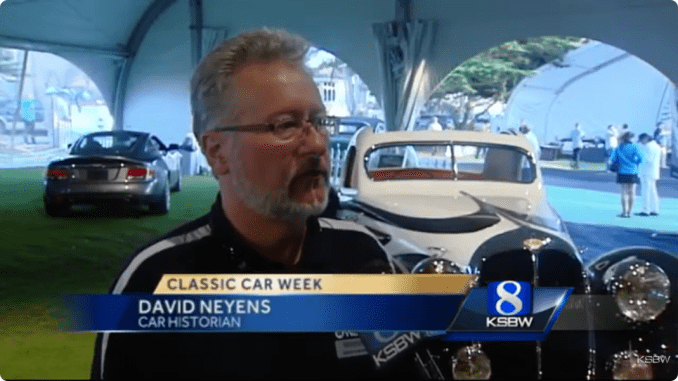
By David C.R. Neyens, Motorcopia
I’ve been writing classic and collector vehicle descriptions and working in high-end collector car sales and auctions for the past 18 years. My clients have earned millions from my work because I understand not just the cars themselves, but how the market actually functions.
And right now, I’m watching how the market is changing in a coordinated way I’ve never seen before.
The collector car market that you think you know? It’s being quietly reorganized at a fundamental level while most people are just watching auction results and tracking their favorite models.
Let me show you what’s really happening, because if you don’t understand this, you’re already behind.
The Market I Started In vs. The Market We Have Now
When I started in this business in early 2008, the collector car world was fragmented. You had independent auction houses competing against each other. Standalone magazines. Separate events. If you wanted to sell a car, you would call a specialist dealer or consign it to your regional auction house. If you wanted information, you subscribed to a magazine or joined a marque club or a broader organization such as the AACA or CCCA.
For many years, the customer journey involved maybe a dozen different independent touchpoints, bridged by marque experts and conversations among the various market players.
That world is disappearing fast.
What’s Being Built Right Now
Three major groups are assembling something completely different: complete ecosystems where they control everything from the content you consume to the auction paddle in your hand.
Let me break down what I’m seeing:
The duPont/RM Sotheby’s/Canossa Empire
These guys have been aggressive and smart after running high-end auctions around much of the world and watching their archrivals at work:
- RM Sotheby’s – Top-tier auctions, strong UK/European presence since 2007
- Sotheby’s Motorsport (SOMO) – High-end online auctions, specializing in modern supercars
- duPont Registry – Where high-end cars get listed and featured in print and online
- Petrolicious – Some of the best automotive content and storytelling on the internet
- Canossa – Elite-level classic car events and events management. Broad European and growing U.S. presence. Exceptionally strong growth since its foundation in 2011. Presents Cavallino Ferrari events in Palm Beach, USA, Milan, Italy, and the Middle East
- Cavallino magazine – owned by Canossa
- Elferspot – European Porsche marketplace
Think about that for a second. They can feature a car in a Petrolicious story/video, list it on duPont Registry, showcase it at a high-profile Canossa-managed event, and sell it at RM Sotheby’s-all in-house.
Hagerty’s Play
Hagerty started with insurance and valuation tools, but they’ve been building fast:
- Broad Arrow Auctions – Their auction platform
- Hagerty Marketplace – Online transactions
- Hagerty Drivers Club – Community and events
- Hagerty Media – Content and those valuation guides everyone uses
Here’s what’s interesting: Hagerty’s valuation tools help set the market. Now they’re also selling in that market through Broad Arrow and Hagerty Marketplace. That’s vertical integration.
Gooding/Christie’s: The Prestige Angle
Since its inception in the early 2000s, Gooding and Company is the official auction house for the world-famous Pebble Beach Concours d’Elegance. In 2025, they partnered with the venerable Christie’s auction house, adopting a different approach that positions collector cars alongside fine art for the ultra-wealthy.
And they just announced they’re bringing a special edition of the renowned Retromobile show and auctions from Paris to New York this November. That’s not a small move. That’s bringing long-standing European prestige directly into the American market.
The Gooding/Christie’s Strategy: Fine Art Positioning
Gooding & Company’s partnership with Christie’s and the expansion of Retromobile from Paris to New York (November 2025) represents a fundamentally different strategic approach.
The Alternative Asset Thesis
While Hagerty and duPont/RM Sotheby’s build automotive-specific ecosystems, Gooding/Christie’s is positioning collector cars within the broader alternative asset class:
Strategic Elements:
1. Fine Art Association:
- Christie’s brings 250+ years of fine art auction credibility
- Positions cars alongside paintings, sculptures, jewelry, wine
- Appeals to collectors who diversify across multiple passion assets
2. Ultra-High-Net-Worth Targeting:
- Focuses on High Net Worth collectors
- Emphasizes provenance, rarity, and investment thesis
- Targets collectors who view cars as portfolio diversification
3. European Prestige Import:
- Retromobile is one of Europe’s most prestigious automotive events
- Bringing it to New York imports that cachet to American market
- Directly challenges established American auction calendar
4. Differentiation Through Positioning:
- Not competing on ecosystem breadth
- Competing on prestige, exclusivity, and asset class positioning
- Targeting a different (though overlapping) collector demographic
The November 2026 Test
Retromobile New York (November 2026) will be a significant test:
- Can European event prestige translate to American market?
- Will it attract consignments that might otherwise go to traditional American auctions?
- Does the Christie’s association elevate perceived value?
The timing is also strategic-November positions it away from the crowded January (Arizona) and August (Monterey) calendar, potentially capturing consignments that might otherwise wait for those traditional windows.
The Venue Wars: Watch This Closely
Here’s where you can see the competition getting real.
For Monterey Car Week August 2025:
Broad Arrow (Hagerty) just took over the Quail Lodge slot, formerly long-held by Bonhams (now Bonhams | Cars. If you know Monterey Car Week, The Quail is a premium location. Hagerty is making a statement: we’re now competing at the absolute top tier.
Bonhams got pushed to Laguna Seca in conjunction with the world-famous Rolex Monterey Motorsports Reunion held each August. They’re pivoting to the racing heritage angle. Not bad at all.
This isn’t about finding available space. This is about positioning and prestige. And Hagerty just claimed the high ground.
What I’m Watching: The Porsche Setup
Here’s something most people haven’t connected yet.
duPont/RM Sotheby’s recently bought Elferspot – the biggest Porsche marketplace in Europe. Why would they do that?
Because Porsches are next to pop and they know it.
Look, Ferraris have priced out even wealthy collectors. Prices have risen dramatically in early 2026. Entry-level Ferraris that used to be accessible are now $200K+ items. Where will those collectors and enthusiasts go next? Porsche.
Porsche is the last major European marque where you can build a serious collection without needing $50 million. Air-cooled 911s, classic 356s, even modern GT cars-there’s depth in the market and plenty of room to grow. Mark my words: watch Porsche values over the next 24 months.
Why This Matters to You
If you’re a collector, you need to understand this isn’t just business news. This affects how you buy, sell, and do research on classic and collector cars
The good news: Competition between these giants means potentially better events, better services, and better production value.
The reality check: If you’re not plugged into one of these growing ecosystems, you’re at a competitive disadvantage, both informationally and potentially in terms of services.
These groups have data you don’t have. They know what’s being searched, what’s being bid on, and what’s trending before it shows up in public auction results. They can position inventory, create demand through content on a dime, and capture transactions-all in-house.
The independent dealer? The small regional auction house? They’re getting squeezed. Hard.
What I Think Is Coming
I’ve been in this business long enough to connect the dots and see patterns. Here’s what I expect:
More acquisitions. There are still independent media properties, specialized marketplaces, and regional events that make sense for these groups to buy.
Tighter integration. The connections between content, community, and commerce will get more sophisticated. Expect better data utilization and more targeted, laser-focused marketing.
Category positioning. These groups will strategically focus on specific marques and categories they want to grow, then profit from, as those markets rise. (Again: watch Porsches.)
Implications for Market Participants
For Collectors:
Advantages:
- Improved services and event quality driven by competition
- Integrated platforms for research, community, and transactions
- Professional marketing and presentation
Considerations:
- Potential information asymmetry if operating outside these ecosystems
- Concentration of market influence in fewer hands
- Questions about independent valuation and market-making
For Independent Dealers and Auction Houses:
The consolidation creates competitive pressure. Independents must differentiate through:
- Specialized expertise in specific marques or categories
- Personalized service that large organizations can’t replicate
- Regional or niche market focus
The two-tier market. We’re heading toward a bifurcated industry with major consolidated ecosystems on one side, specialized independents serving tightly defined, specific market niches on the other.
Why I’m Writing This
Look, I love this business. I’ve spent 18 years helping clients navigate it successfully. My work has helped some of them earn millions because I understand how things actually work, not just how they appear to work.
And right now, understanding who controls what is as important as understanding the cars themselves.
Most automotive media won’t tell you this story because they’re either part of these ecosystems or don’t want to bite the hand that feeds them advertising revenue.
But Motorcopia exists to give you the insider perspective you need. No BS. Just what’s actually happening.
Conclusion – What’s Next
This consolidation represents the maturation of the collector car market into a more structured, professionalized industry. Understanding these dynamics-who owns what, how ecosystems function, and where strategic positioning is occurring-is increasingly important for effective market participation.
The question isn’t whether consolidation will continue. The question is how market participants adapt to this new structure.
This is Part 1. I’m gathering insights from dealers, auction house insiders, and collectors about what they’re seeing that I can’t observe from my position. Part 2 will take those insights and reveal what they are perceiving and what’s actually happening behind the scenes.
Want to contribute? Reply – either in the Comments field below the post on www.motorcopia.com or directly by emailing me at admin@motorcopia.com with what you’re observing. On or off the record-your choice! Just let me know your preference.
Subscribe to the Motorcopia Newsletter to get Part 2 and stay ahead of what’s coming.
Because in this market, information is worth more than you think.
Special thanks to Cynthia A. Meitle of CARPR USA for providing the impetus and concept for this article. If you have an event, publication, or new product/service in the collector car realm, be sure to contact her for expert promotion and event management!
David Neyens has worked in collector car sales and auctions for 18 years, writing thousands of detailed vehicle descriptions and helping his clients navigate the market successfully. His expertise has helped clients earn millions through informed market participation. Motorcopia provides the analytical perspective serious collectors need to understand not just cars, but how the market actually functions. Motorcopia delivers the insider intelligence you won’t find anywhere else.
Subscribe to the free Motorcopia Newsletter today!
I began my collector car auction journey in 1987. Having traded as a vocation since then. How can you ignore the Bring-A-Trailer/ Mecum book of business in presentation like this? BaT has 1.7 million sets of eyes alone on the platform. Mecum is the oldest and largest privateer auction house left. With very young and capable family members to grow.
Remember, what goes up, must come down. Since your start AFTER 2008, you’ve missed 2 significant down cycles since the dawn of the modern collector car auction industry. These Wall Street initiatives in our hobby/industry are to date, untested in a down cycle.
It’s coming, let’s see how this plays out.
You’re giving Bonhams way too much credit. They’re at Laguna Seca because the Monterey peninsula has no viable alternatives to host an auction, not because they’re fronting to “focus” on anything. My best advice to consignors is to only do business with Bonhams at a 0% sellers commission. I promise they’ll take your deal because they’re floundering to stay relevant. Look into the department’s management and you’ll discover why not to sell with Bonhams. Why work with a company that’s just flipping cars to dealers which are also its core of consignors. The advertising lacks because they’re working with a company that has dozens of additional departments they feel are more relevant than the car sales, thus resulting in lack-luster (if any) advertising. Don’t you want the best results for the sale of your car? If so, go to an auction house that’s singularly focused on cars.