
What Insider Activity Measures
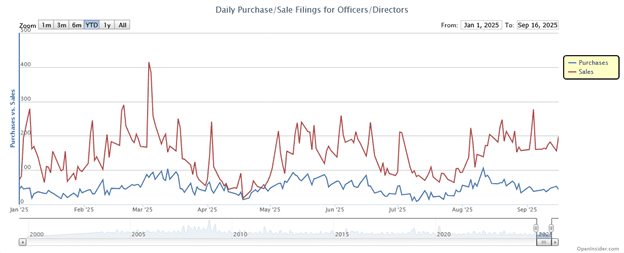
Every week, executives, directors, and large shareholders at public companies file Form 4 reports when they buy or sell stock in their own firms. Sites like OpenInsider aggregate this data, producing charts that reveal whether insiders are accumulating shares (confidence) in their company, or cashing out of their company’s stock, signaling caution or a swing in sentiment toward diversification.
- High Buy/Sell Ratio → Insiders believe stocks are undervalued; they’re buying aggressively.
- Low Buy/Sell Ratio → Insiders are selling heavily, often near market highs.
This data is often called a “smart money” signal, because nobody knows a company’s prospects better than the people running it.
Why It Matters for Investors
- Buying is rare and deliberate. Executives usually only buy with personal capital when they think shares are cheap.
- Selling is common but telling. While insiders often sell to diversify or fund personal needs, broad waves of insider selling frequently coincide with overheated markets.
- Analysts track this activity as a sentiment gauge, especially valuable during inflection points in equity cycles.
Implications for Liquidity and Discretionary Spending
Here’s where the link to collector cars becomes interesting:
- Insider Buying Surges: Capital is being reallocated back into equities (stocks). Insiders see better returns in public markets, leaving less near-term liquidity for discretionary or passion-driven spending. Collector car markets may cool at the margin.
- Insider Selling Surges: Executives are harvesting gains. Those proceeds often find their way into tangible assets — real estate, art, wine, and yes, collector vehicles. A wave of insider selling can signal fresh liquidity flowing into discretionary markets.
Correlation with Collector Cars
The relationship isn’t perfect, but clear patterns do emerge:
- Inverse Correlation: Heavy insider buying tends to divert money away from collectibles and back into stocks.
- Direct Correlation: Heavy insider selling tends to free up capital for diversification. Collector cars often benefit in these cycles, especially at the top end.
- Macro Matters Too: Interest rates, credit availability, and cultural trends amplify or blunt these effects.
The Motorcopia View
Tracking insider buy/sell ratios isn’t just about equities. It’s about following the capital flows of the wealthy decision-makers most likely to participate in collector markets.
- If insiders are buying their company stocks: Expect equities to absorb liquidity, leaving collector markets steadier but less frothy.
- If insiders are selling their company’s stocks: Watch for increased flows into hard assets — with collector cars positioned as both a diversification play and a passion-driven store of value.
Bottom Line: The insider charts are a window into how discretionary capital may shift. For investors and collectors alike, understanding these flows adds another layer of intelligence to timing buys, holds, and sales in the collector car market.
This chart is from www.openinsider.com, showing the divide between company insider share-selling activity and buying for the past year, at the time of writing for this article. With very few exceptions, when insiders bought stocks in their companies, insider selling has consistently outpaced buying – not just over the past 12-month timeframe, but since the chart’s inception back in November 1999.
Don’t take it from us, see it for yourself HERE. Very plainly, across virtually all timeframes and with few exceptions, this chart explains why knowledgeable company executives, “the smart money,” have been piling into top-notch collector cars for the past quarter-century.

⚑ Motorcopia Market Insights – Where passion meets performance, on the road and in the financial charts.
Motorcopia. Independent, Impartial, Data-Driven.
Leave a Reply