
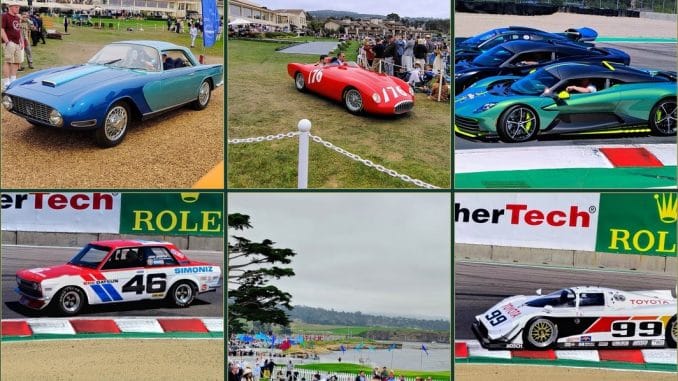
A vocal corner of today’s collector-car media argues Monterey Car Week is overpriced, oversaturated, and irrelevant to the market most collectors actually trade in. Having just spent the week on the ground – from several auctions, shows, and events to this year’s 75th edition of the Pebble Beach Concours d’Elegance, I concede the critics’ facts but reject their conclusion. You can’t see it all, and that’s not a bug; it’s what makes an oversubscribed week like this one work.
It’s become fashionable lately to build an online following by telling people to skip Monterey Car Week – that it’s overpriced, oversaturated, and irrelevant to the market where many people actually participate. I’ve read the posts, watched the videos, and heard the arguments made with real conviction before I flew out for Monterey Car Week this August. Having now enjoyed much of the week on the ground, I disagree with almost all of it, and I’d like to tell you why.
Where it All Started
The Pebble Beach Concours d’Elegance dates to 1950, when it began almost as an afterthought – a bit of style for spectators between heats of the nascent road races held in the Del Monte Forest. This year officially marked its 75th edition. The auction side of the week is younger. In 1986, my friend Rick Cole ran the first collector-car auction held in conjunction with the Monterey Historic Races at Laguna Seca, with the blessing of his friend and mentor Steve Earle. It was just three events back then – two well-established, and one in its infancy but poised for significant long-term expansion beyond the most optimistic forecasts.
Everything since has been additive. RM Auctions (now RM Sotheby’s) acquired the Monterey sale from Rick Cole Auctions in 1999 and used it as a springboard into new markets across the U.S., then England, then Continental Europe. Gooding and Company (now Gooding Christie’s) followed, then Bonhams, then Russo and Steele, Mecum, and Hagerty’s Broad Arrow. Each auction logically arrived because the week already had the audience – not the other way around. That’s worth remembering when someone describes today’s sprawl as evidence the whole thing has lost its way. It didn’t lose its way. It grew steadily, one profitable year at a time, exactly the way successful events tend to grow – starting, in a very real sense, with my friend’s Laguna Seca auction tent.
What often gets left out of the “Monterey is a circus” argument is everything that isn’t a circus. Pacific Grove’s Aston Martin-themed Astons on the Avenue, the Little Car Show for anything under 2.0 liters, Seaside’s gleefully anti-establishment Concours d’Lemons, and the one I’d hold up against any event in the hobby anywhere – the PCA Werks Reunion. It’s entirely volunteer-run, free to attend, and it had more genuine enthusiasm per square foot than almost anything else I experienced during Car Week this year. Bottom line: you don’t need a six-figure bidder credential to have a great week here.
The Case Against Monterey – And Where It’s Actually Right
A vocal corner of collector-car media has spent the past few years making the case that Monterey isn’t worth attending – too expensive, too sprawling, too disconnected from the market most of us actually participate in. I want to take the strongest version of that argument seriously, because dismissing it outright would be intellectually lazy, and because some of it is indeed true.
The critics are right that you cannot see everything at Monterey. Across a few days in August, five auction houses run well over a thousand lots between them, often with multiple gavels falling simultaneously across venues that can be 30 to 80 minutes apart in congested Car Week traffic, with 17-Mile Drive to Pebble Beach restricted during peak days. I felt that reality myself, plotting a schedule that meant deliberately missing things I wanted to see. They’re right that this isn’t the market for a sub-$100,000 driver-quality classic – that market trades year-round on Bring a Trailer, through club sales, and at numerous auction venues, not in one curated week on California’s Central Coast. And they’re right that serious capital flows through the top of this market, and that manufacturer marketing budgets underwrite a meaningful share of what happens on the Monterey Peninsula.
Where I part ways with this argument is precisely what those facts are supposed to prove. You cannot see everything at Monterey – correct, and that is also true of the Le Mans Classic, Goodwood Festival of Speed, or any car-related event built from abundance rather than scarcity. That’s not a flaw to be solved; it’s the nature of a genuinely oversubscribed week, and it means everyone gets to build their own version of it.
Monterey isn’t the comp set for an ordinary collector car – also correct, but Monterey never claimed to be that. It’s the week where the rarest cars in the world change hands and history is made in real time, not a referendum on what a cool car down the street is worth. Those are two different jobs. Holding one accountable for failing at the other isn’t a fair critique. It’s a category error.
The “it’s a scene, not a show” argument is the one I find least convincing, because it erases the volunteer-run, unglamorous, deeply sincere corner of the week, including club and community events, not to mention the people who drove their own cars there and drove them back home again. That crowd wasn’t chasing a brand tent or auction glory. It was chasing the same things that got most of us into this hobby in the first place.
Room for Everybody
None of this means the Monterey Car Week critics are wrong to stay home. If the cost, travel, crowds, and the sprawl aren’t worth it to you, that’s a completely reasonable conclusion, and nobody needs to justify skipping a car show. What I’d push back on is the idea that the rest of us were fooled for showing up.
I took the expensive flights, faced the traffic and the impossible schedule, and I missed some of the things I wanted to see. In exchange for that cost and effort, I stood in front of cars that might never be in the same place at the same time again, watched history get made in real time, and spent a week with people who love this hobby exactly as much as I do. New friends and contacts were forged, and I reconnected meaningfully with longtime friends. If that’s a circus, I’d rather have been under the tent than just reading about it from three thousand miles away.
There’s plenty of room at Monterey Car Week for the eight-figure auction hammer and the free shows, for the loudest online skeptics and the reporters who stood in the crowd anyway. That’s not a contradiction. That’s just proof of how vast this hobby actually is.

Motorcopia | Collector Car Market Intelligence
Get the edge at www.motorcopia.com
Subscribe FREE to the Motorcopia Newsletter
David, SPOT ON! MCW is a sensory overload in the very best of ways. From the gut rumbling baritone of Trans AM series cars in the Laguna Seca paddock to the pristine experience of the Pebble Beach Concours and all of the eye-popping auction sales in between. Been there, done that, got the T-shirt…20+ times!
Totally agree. A feast for the senses and unforgettable.